Why the AI + Stablecoins сould become one of the defining themes of the coming years
Contents
- Introduction
- How AI and stablecoins complement each other
- Autonomous AI agents and machine-to-machine payments
- Where this combination can already be applied
- Why this matters for DeFi, Web3, and the digital economy
- Risks, limitations, and regulation
- Conclusion
Introduction
The combination of AI and stablecoins is increasingly moving beyond the boundaries of the crypto market. It affects not only blockchain-based settlement, but also service automation, digital commerce, cross-border payments, and the architecture of online platforms. At the intersection of these areas, an environment is emerging in which money becomes part of software logic, and financial operations are embedded directly into the work of algorithms.
Interest in this topic is growing because artificial intelligence needs a convenient way to make fast and predictable payments. Conventional banking tools are not always well suited for this: they depend on schedules, intermediaries, jurisdictions, and manual procedures. Stablecoins, by contrast, offer a clear unit of account, constant availability, and integration with digital infrastructure.
How AI and stablecoins complement each other
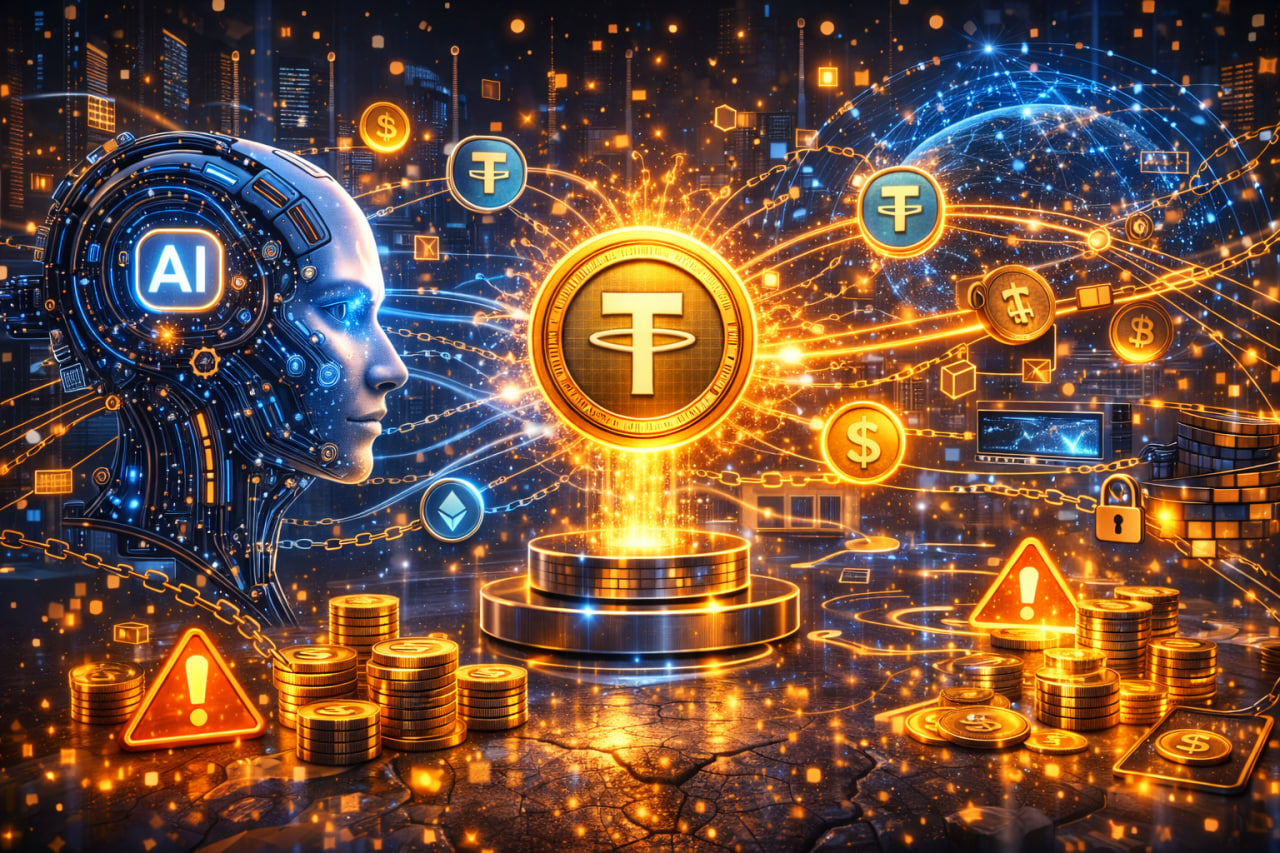
For autonomous systems, three properties of money are especially important: programmability, speed, and nominal stability. That is why programmable money for AI looks like a logical extension of the digital economy’s development. It is easier for an algorithm to work with a tool that can be embedded in code than with traditional payment logic that requires banks, operators, and lengthy coordination.
Stablecoins give AI not just a payment method, but a predictable settlement environment. This is where AI-managed stablecoin transactions emerge, with decisions about payment, fund allocation, or contract execution made automatically on the basis of predefined rules. This creates stablecoin-based automation, in which money becomes part of a machine process rather than a separate final step.
Autonomous AI agents and machine-to-machine payments
Autonomous AI agents are already being viewed as future participants in digital markets: they can purchase data, pay for computing power, order API calls, allocate budgets, and execute financial instructions without constant human oversight. In this model, stablecoins are especially important because they reduce currency uncertainty and simplify cross-platform settlement.
In the service economy, this creates the foundation for machine-to-machine payments, where one algorithm pays another for a resource. In such an environment, the following are especially in demand:
- AI micropayments for data, traffic, content, and computing power.
- Real-time stablecoin settlement between platforms and digital services.
- Automatic payouts for completed actions without manual confirmation.
- Continuous small-value transactions within distributed applications and network infrastructure.
This model is particularly important where the price of a service is low but the number of transactions is high. In such scenarios, traditional channels are either too expensive or too slow.
Where this combination can already be applied
Practical use cases for AI in the crypto industry are already visible across several directions. The most obvious of them can be summarized in the table below.
| Area | How the combination of AI and stablecoins is applied |
|---|---|
| Payment services | AI in crypto payments helps route transfers, manage limits, and choose the most efficient settlement channels. |
| International settlement | Cross-border AI payments accelerate transfers between countries and reduce dependence on banking intermediaries. |
| Trading strategies | AI trading with stablecoins allows algorithms to reallocate liquidity and quickly lock in value in digital dollars. |
| Web3 services | Stablecoin infrastructure for Web3 gives applications a unified settlement layer for subscriptions, fees, and payouts. |
| Financial platforms | Tokenized finance and AI combine analytics, performance tracking, automatic execution of conditions, and digital assets within a single system. |
This is no longer about the theoretical compatibility of two trends, but about the emergence of a new operating model in which algorithms can not only analyze, but also pay.
Why this matters for DeFi, Web3, and the digital economy

For DeFi, this topic matters because stablecoins in decentralized finance are gradually evolving from trading liquidity into a universal settlement layer. If they were once primarily a tool for storing value between trades, they are now becoming the basis for automatic payments, treasury management, revenue distribution, and the machine execution of protocol rules.
More broadly, an AI economy and digital dollars are taking shape, where payments begin to serve not only people, but also software-based entities. This strengthens the role of Web3 as an environment in which money, application logic, and access rights are combined within a single infrastructure. These changes are especially visible in the following areas:
- Liquidity and treasury management for protocols.
- Automatic payouts to contributors, nodes, and data providers.
- Embedded payments in SaaS platforms, marketplaces, and decentralized applications.
- Hybrid financial models where AI makes decisions and a stablecoin executes settlement.
The shift from speculative use cases to practical ones makes the market more mature: the key factor is no longer token growth, but the efficiency of financial infrastructure.
Risks, limitations, and regulation

Despite the advantages, the risks of AI and stablecoins remain significant. A model error, oracle failure, flawed smart contract logic, or interface vulnerability can trigger a chain of incorrect payments. The greater the system’s autonomy, the more important it becomes to control limits, verify data sources, and maintain emergency stop mechanisms.
A separate issue is the regulation of AI-managed payments. This is where compliance requirements, identification, transaction monitoring, and responsibility for an algorithm’s actions intersect. The main constraints look like this:
- Lack of transparency in AI decision-making during financial execution.
- Difficulty in allocating responsibility between the developer, the operator, and the service owner.
- Risk of violating AML and KYC requirements in cross-border scenarios.
- Legal uncertainty for fully autonomous payment models.
Regulatory clarity will largely determine the pace at which such solutions are adopted in the mainstream economy.
Conclusion
The future of AI and stablecoins is becoming an important topic not because it is a fashionable combination of two technologies, but because of their practical compatibility. Artificial intelligence needs a means of settlement that can be embedded in code, scaled, and used globally. Stablecoins meet this need better than most traditional instruments.
That is why in the coming years the market will likely discuss not the abstract impact of technology, but specific models in which AI analyzes, makes a decision, and initiates a payment, while a digital dollar executes settlement. This is the main value of the combination: it opens the way to a more automated, faster, and more practical financial environment.