The Impact of RWA on Traditional Markets
Contents
- Introduction
- What is the tokenisation of real-world assets
- How the RWA model works
- Which assets are most commonly tokenised
- Why RWA matters for the crypto market
- The link with DeFi and the interest of major players
- How RWA affects traditional markets
- Advantages of RWA
- Risks and limitations of the RWA market
- Legal and technological risks
- Prospects of the RWA market
- Conclusion
Introduction
Tokenisation of real-world assets is the process of converting familiar assets into a digital form on the blockchain. This category includes real estate, bonds, funds, commodities and other instruments of the traditional financial market.
The essence of RWA is simple: the asset itself remains real, but the right to it or a share in it can be structured through a token. This approach affects not only the crypto market. It impacts liquidity, accessibility of investments and the infrastructure of traditional finance.
What is the tokenisation of real-world assets
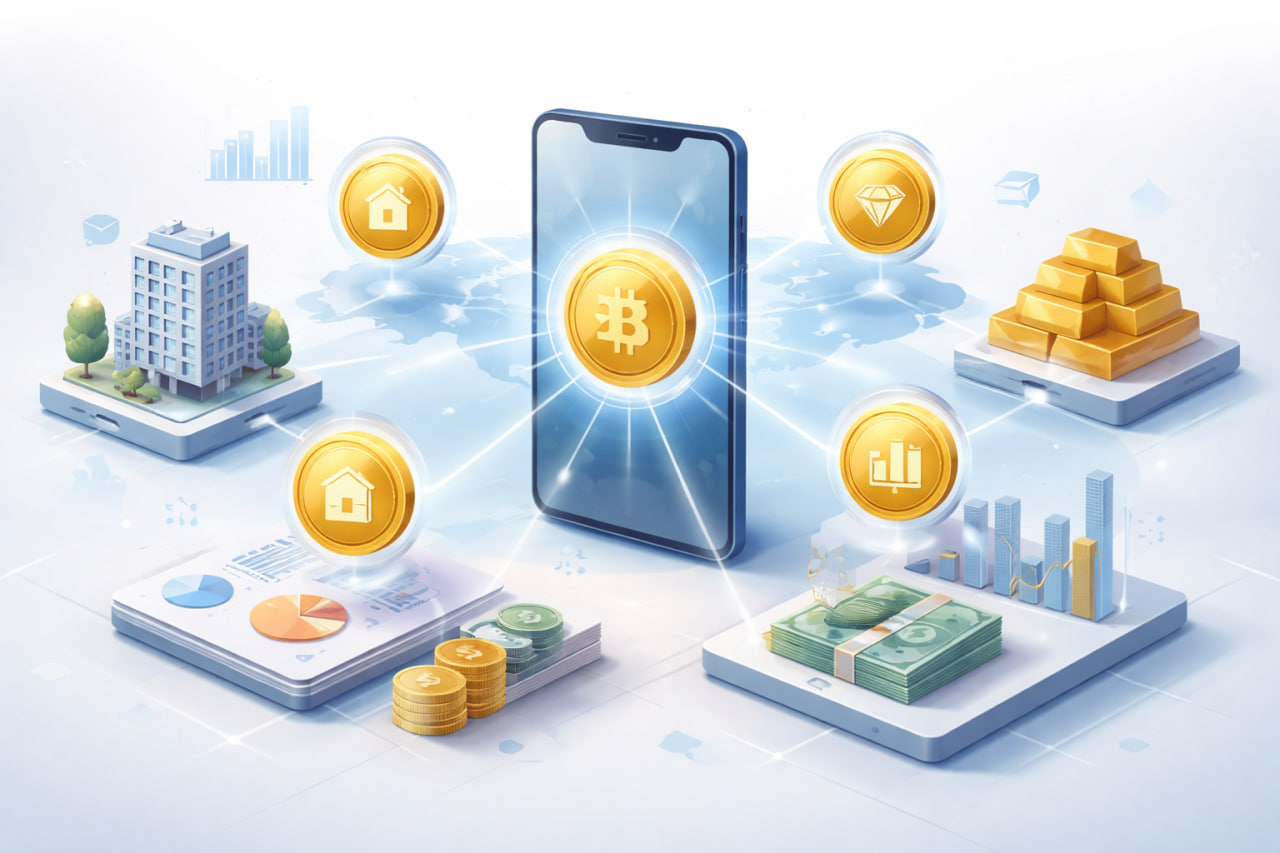
Tokenisation of real-world assets, or RWA, is a model in which a physical or financial asset receives a digital representation on the blockchain. Such a token may represent not the entire asset, but a part of it, a right to income, or another form of participation.
The practical meaning of RWA is that an investor does not always need the entire asset. In many cases, a share in real estate, a bond, a fund, or a commodity instrument is sufficient. Tokenisation makes this format more convenient for accounting and circulation.
Most commonly considered in the RWA format are:
- Real estate
- Bonds
- Fund shares
- Commodity assets
- Credit instruments
The key idea of RWA is to simplify access to real assets and make working with them more convenient in a digital environment.
How the RWA model works
The RWA model is built on a simple structure: there is an underlying asset, there is a token linked to this asset, and there is a blockchain, where rights and transactions are recorded. In this scheme, a smart contract is also used. It defines how the token operates and helps automate part of the processes.
In simplified form, the process looks like this: first, an asset is selected, then the rights that the token should represent are defined, after which the token is issued on the blockchain. Investors can then buy, hold, or transfer such tokens within the defined model.
Four elements are important in this system:
- Underlying asset
- Token
- Blockchain
- Smart contract
The advantage of this model is that it simplifies the issuance, accounting, and circulation of assets. Ownership information is stored in a single system, transactions are easier to track, and some operations can be executed faster.
Which assets are most commonly tokenised

The real-world asset tokenisation market has already moved beyond test cases. Today, assets most often considered in the RWA format are those with clear pricing, a clear structure, and stable investor interest. These primarily include real estate, bonds, funds and other traditional financial instruments.
Such assets are easier to convert into digital form and integrate into blockchain infrastructure. They already have market logic, demand, and a clear ownership model. As a result, the tokenised asset market is gradually becoming more accessible not only to the crypto audience but also to participants of traditional finance.
Real estate
Real estate tokenisation is one of the clearest examples of RWA. The issue with this market is that entry often requires a large amount of capital. Purchasing an entire property remains a complex task for a private investor.
Tokenisation changes this approach. A single property can be divided into shares and represented as tokens. As a result, the investor gains access not to the entire property at once, but to a portion of it. This lowers the minimum entry threshold for the segment and expands the range of market participants.
For the real estate market, two effects are important:
- Fractional ownership becomes simpler
- The entry barrier for investors is reduced
At the same time, a real asset still stands behind the digital form. What changes is not the asset itself, but the way ownership shares are recorded and accessed.
Bonds and funds
Tokenisation of bonds and funds shows that RWA affects not only physical assets but also familiar financial market instruments. This is important for banks, funds, and institutional investors that already work with such assets in traditional infrastructure.
Bonds have a clear structure: maturity, yield and issuer. Funds have a set of assets and an investment strategy. When such instruments receive a digital form, ownership accounting becomes simpler, the movement of shares is easier to track, and access to instruments can become more convenient.
At this stage, tokenised bonds and tokenised funds appear to be among the most realistic directions for integrating blockchain into traditional finance.
Why RWA matters for the crypto market
For the crypto market, RWA matters because real assets connect digital tokens with the economy outside the blockchain. For a long time, the crypto market developed mainly within its own infrastructure, where the key role was played by native tokens, volatility and internal liquidity. Tokenisation of real-world assets changes this logic.
When assets appear on the blockchain that are backed by real estate, a bond or a fund, the digital asset market looks less closed. It gains a connection with instruments that have long existed outside crypto and have understandable value. In this sense, RWA can be viewed as one of the directions that brings blockchain and traditional finance closer together.
The link with DeFi and the interest of major players
One of the key advantages of RWA is that tokenised assets can be used within DeFi. This means that assets from the real world can become part of a decentralised financial environment rather than existing separately from it.
For DeFi, this is an important step. Previously, most such solutions were built around crypto assets themselves. Now the system can include instruments backed by external value. This makes the market more resilient and expands blockchain use cases.
In such an environment, tools that help demonstrate real trading results, trade history, and key portfolio metrics in an open and understandable format. For a trader, this is an important advantage: when statistics can be shown to an audience, partners, or potential investors, trust in their results grows faster.
Interest from banks, funds, and large companies also looks logical. It shows that asset tokenisation is gradually being perceived not as a speculative experiment, but as a model with practical application and a clear structure.
How RWA affects traditional markets

Tokenisation of real-world assets affects traditional markets not only at the level of technology, but also at the level of the structure itself. The way assets are accessed changes, as do the order of transactions, the accounting of rights, and the role of intermediaries. As a result, RWA is increasingly viewed as one of the instruments that can affect traditional finance.
The key changes are conveniently shown in the table:
| Direction of impact | What changes |
|---|---|
| Growth in liquidity and accessibility | Large assets can be divided into parts, which lowers the minimum entry threshold in individual market segments |
| Reduction of costs and faster operations | The accounting of rights, settlements, and the transfer of shares can take place more simply and quickly |
| Changing role of intermediaries | Intermediaries remain, but their functions shift toward control, legal clarity, and infrastructure reliability |
Growth in liquidity and accessibility
One of the strengths of RWA is the ability to divide a large asset into small parts. Because of this, the market is no longer closed only to large capital. If entering certain segments previously required large sums, an investor can now gain access to only a portion of an asset.
This is especially noticeable in segments such as real estate, bonds and funds, where the cost of entry remained high for a long time. The lower the minimum entry, the wider the range of participants and the higher the likelihood of more active circulation of the asset on the market.
Reduction of costs and faster operations
The traditional financial market is often built around a long chain of actions. A transaction must be formalised, rights must be verified, data must be reconciled, and the transfer of the asset itself may take time. All of this makes the process heavier and more expensive.
Blockchain does not solve all problems at once, but it can simplify an important part of this scheme. If an asset exists in tokenised form, the accounting of rights and the movement of shares become more direct and understandable. This helps reduce the number of unnecessary steps and makes individual operations faster.
Changing role of intermediaries
Tokenisation does not remove intermediaries completely. Banks, brokers, custodians, platforms, and legal structures remain part of the market. But their functions are gradually changing.
If previously most of their role was built around manual accounting, reconciliation, and execution, then in the new model the emphasis shifts toward control, compliance, legal clarity and infrastructure reliability. In other words, the market is changing not by rejecting intermediaries, but by redistributing their tasks.
Advantages of RWA
The advantages of RWA are related to the fact that tokenisation makes working with assets more flexible and more convenient for the market. The individual effects have already been explained in detail in the previous sections, so here it is appropriate to leave a summary.
Key advantages of RWA:
- A lower entry threshold in certain segments
- More transparent accounting of rights and transactions
- Broader access to investment instruments
- More convenient circulation of assets in a digital environment
Taken together, these properties make the tokenisation of real-world assets a notable direction at the intersection of the crypto market and traditional finance.
Risks and limitations of the RWA market
The real-world asset tokenisation market has strengths, but it also has limitations. For this reason, RWA cannot yet be considered a fully mature segment. The technology looks promising, but there is still a noticeable gap between a theoretically attractive model and stable operation in the real market.
The main limitations of RWA are connected with the following points:
- Regulation
- Rights to the underlying asset
- Reliability of platforms
- Smart contracts
- Immaturity of infrastructure
A token by itself does not solve all issues. If it is backed by a weak legal structure, a non-transparent platform, or disputed rights to an asset, the resilience of such a model decreases.
Legal and technological risks
One of the main barriers for the RWA remains legal uncertainty. An investor needs to understand exactly what they are buying: a share in an asset, a right to income, or only a digital record within a platform. If the link between the token and the real asset is weakly defined, serious problems may arise in a dispute.
Legal risk usually comes down to several questions:
- Who actually owns the underlying asset
- What rights does the token grant
- How these rights are protected
- What will happen in the event of a dispute or platform bankruptcy
No less important is the technological risk. Even if the idea of tokenisation itself looks reliable, the market still depends on the quality of the platform, code, and digital infrastructure. An error in a smart contract, a failure in the accounting system, or weak service protection can negatively affect investors just as much as an unsuccessful legal scheme.
The most vulnerable points include:
- Errors in smart contracts
- Platform failures
- Problems with data storage
- Security vulnerabilities
At this stage, the tokenised asset market remains a segment where interesting opportunities coexist with real risks. For large-scale growth, this may still be insufficient without a more stable legal framework and a more reliable technical environment.
Prospects of the RWA market

Without excessive optimism, the most realistic scenario for RWA is gradual integration rather than a sharp restructuring of the entire financial system. Tokenisation is unlikely to replace the familiar mechanisms of the traditional market in the short term, but it can certainly occupy a noticeable place in certain segments.
The most likely growth directions are:
- Bonds
- Funds
- Real estate
- Institutional solutions
These segments look the most suitable for implementing RWA, as they already have a clear structure, demand, and a logical framework for managing rights to an asset. Most likely, the market will develop through such targeted directions rather than through a complete replacement of traditional finance.
At the same time, the future of RWA depends not only on blockchain. The growth of this market will likely also be influenced by regulators, banks, and investment platforms, as well as by the willingness of major participants to adopt the new model.
Conclusion
Tokenisation of real-world assets is a tool that can affect access to assets, liquidity, and the structure of traditional financial markets. RWA makes the market more flexible and opens the way to a more convenient model for recording and circulating rights.
At the same time, such a model should be assessed without inflated expectations. The market has strong potential, but it also has limitations that still restrain its development. Therefore, RWA is reasonably viewed as a direction that is gradually changing individual segments of the financial system rather than as an instant replacement for traditional mechanisms.