AI Crypto Scams in 2026

Contents
- Introduction
- Why AI makes crypto scams cheaper and more scalable
- Deepfake fraud in crypto
- Fake support for exchanges and wallets
- Website clones and fake crypto platforms
- Next-generation crypto phishing
- The most common AI crypto scams in 2026
- Why beginners are more likely to become victims
- How to recognize an AI crypto scam
- How to protect yourself from deepfakes, phishing, and fake support
- How crypto projects and exchanges can reduce risks
- Conclusion
Introduction
Right now, the market’s biggest bug is not a smart contract, but user trust. Crypto has long been used to protocol hacks, phishing websites, and fake tokens. But in 2026, the problem has become broader. AI crypto scams allow fraudsters to quickly create deepfake videos, voice clones, fake support, website clones, and personal messages tailored to a specific victim.
Earlier, crypto phishing was often exposed by text mistakes, odd design, and a crude story. Now a scammer can build a neat site in minutes, write an email in good Russian or English, create a “support manager,” and fake the voice of a famous person. According to FBI, cryptocurrency and AI schemes are already among the most costly types of online fraud for users.
Why AI makes crypto scams cheaper and more scalable

AI has lowered the cost of deception. A scammer no longer needs a large team of copywriters, designers, chat operators, and front-end developers. One person can build an entire scheme: text, a landing page, emails, a chatbot, an avatar, a voice, and a set of answers to the victim’s questions.
This makes crypto fraud scalable. If an attacker previously handled dozens of conversations manually, AI now helps run hundreds of chats. A scheme can operate in different languages and target different countries. To the user, it looks like regular support, an investment platform, or an airdrop page.
AI also makes attacks personal. A message can take into account an exchange, a wallet, a token, a country, and even a person’s communication style. That is why fake support and crypto phishing no longer look like crude spam.
Deepfake fraud in crypto
Deepfake fraud is a scheme in which scammers fake the face or voice of a real person. In crypto, they most often copy the CEO of an exchange, a well-known trader, a blogger, a project founder, or a public investor.
The scenario is simple. A user sees a video in which a familiar person supposedly talks about a token giveaway, a new fund, an urgent sale, or a closed round. The voice sounds confident, the face looks real, and the speech is fast and persuasive. Then the victim is led to a fake website where they need to connect a wallet, send crypto, or sign a transaction.
Users believe deepfake videos for three reasons:
- A recognizable face
- A confident voice
- Pressure through urgency
- The promise of quick profit
The main danger is that a person reacts to an image, not to a fact. They see a familiar face and forget to check the domain, wallet address, and the project’s official channel.
Fake support for exchanges and wallets
Fake support is one of the most common AI crypto scams. A user writes about a problem on Telegram, Discord, X, or in the comments. A few minutes later, an account with the logo of an exchange or wallet replies. It speaks politely, quickly, and confidently. Sometimes it is a live scammer, and sometimes it is an AI bot.
The task of such “support” is not to help, but to push the user toward a dangerous action. Scammers may ask them to verify a wallet, follow a link, enter a seed phrase, provide a code from an email, or install a program for a “security check.”
Real support never asks for:
- A seed phrase
- A private key
- A two-factor authentication code
- Full access to the device
- Connecting a wallet to an unknown website
- Installing a suspicious application
If “support” asks for any of this, the user is almost certainly facing crypto phishing.
Website clones and fake crypto platforms

Website clones have become much higher quality. A fake page can almost completely copy an exchange, a wallet, a DeFi protocol, an airdrop landing page, or an investment platform. The differences are often hidden in small details: one extra letter in the domain, a different character in the address, a strange button, or a new wallet connection window.
AI helps quickly create text, FAQs, reviews, interfaces, translations, and even support responses. As a result, a fake website no longer always looks like a cheap copy. Sometimes it looks like a normal product.
Websites that ask users to sign a transaction without a clear purpose are especially dangerous. The user thinks they are receiving tokens, but in reality they are granting permission to withdraw assets.
Next-generation crypto phishing
Old phishing worked through mass emails. New AI schemes are more often targeted. A scammer can write specifically to the owner of a particular wallet, an airdrop participant, a project subscriber, or an exchange customer.
Crypto phishing is most often found in these places:
- Telegram
- Discord
- X
- YouTube
- Google ads
- Comments under posts
- Direct messages
- Fake bots
A beginner has a hard time distinguishing a real channel from a copy. This is especially true if the scammer responds quickly, knows the terminology, and copies the project’s style. In one of its articles, Malwarebytes described an example in which scammers created a fake AI chatbot to sell a nonexistent cryptocurrency. This is a good example of how AI can become not just a text tool, but part of the fraud scheme itself.
The most common AI crypto scams in 2026
| Scheme | What it looks like | Main risk |
|---|---|---|
| Fake airdrop | A website promises free tokens | The wallet receives a malicious permission |
| Deepfake video | A famous person “promotes” the project | The user trusts the face and does not check the link |
| Fake support | A support account sends a direct message | The seed phrase, codes, or access are lost |
| Fake platform | The account dashboard shows “profit” | Withdrawals are blocked by new payments |
| False hack alert | The user is scared with the risk of losing funds | They are led to a phishing website |
Fake giveaways work through greed. The user is promised free tokens, but is asked to connect a wallet or pay a “fee.” Fake investment platforms work through trust in beautiful numbers. Scammers show “profit” in a personal account, draw charts, add reviews, and guide the user through fake support. That is why screenshots of returns and promises of a “stable result” cannot be considered proof. If a trader or service claims to have a strong strategy, it is more important to look at transparent trading statistics: real trades, portfolio dynamics, drawdown, risk, and results over different periods. This approach helps separate normal analytics from a polished story that can easily be assembled with AI.
Why beginners are more likely to become victims
A beginner often does not understand what a seed phrase, transaction signature, wallet permission, smart contract, or website domain is. To them, everything looks the same: a “connect wallet” button, a signature window, a support message, and a link to a website.
Scammers pressure three emotions: fear, greed, and urgency. The user is told that they will lose money, miss an airdrop, or fail to get into a “closed round” in time. At that moment, a person clicks faster and checks details less often.
Crypto’s complex interface also helps scammers. If a person does not understand exactly what they are signing, it is easier to convince them that it is a “routine check.”
How to recognize an AI crypto scam
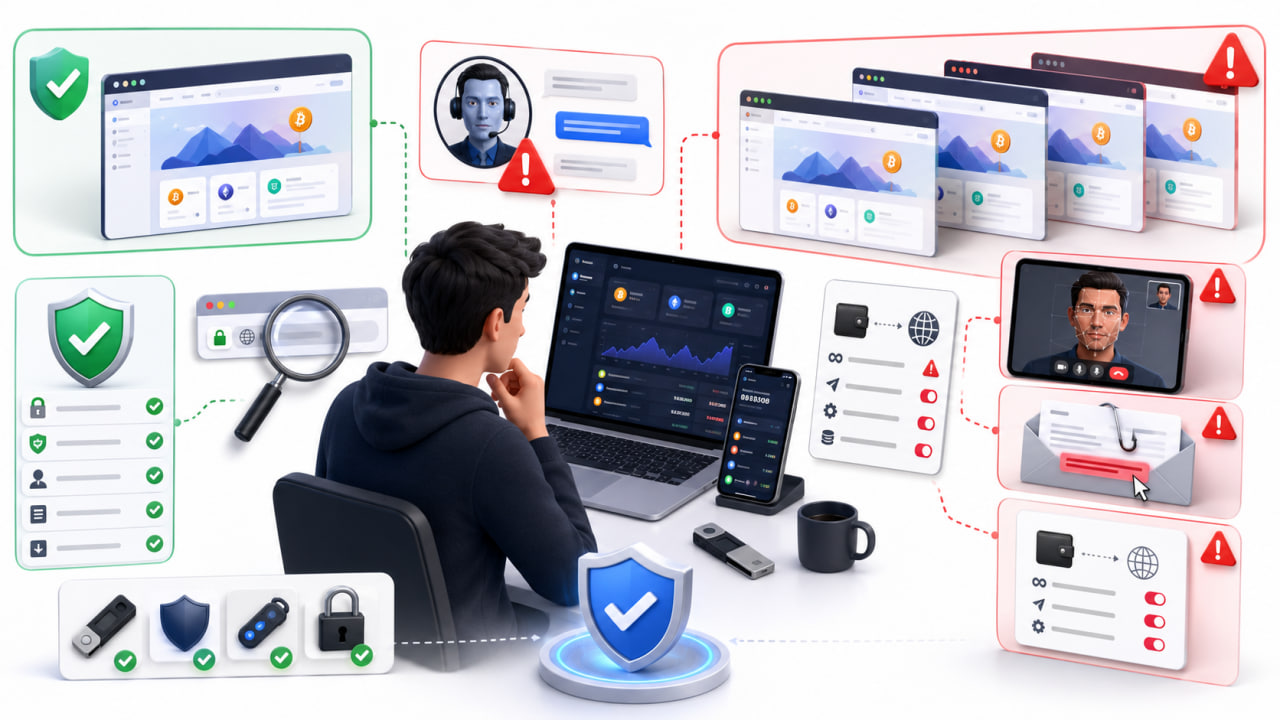
An AI crypto scam has several common signs. They do not always appear together, but even one of them should make you pause.
- You are promised guaranteed profit
- You are rushed and threatened with loss of access
- Support messages you first in direct messages
- The site asks for a seed phrase or private key
- The domain looks official but does not match
- The wallet asks for a strange permission
- A video or voice pressures your emotions
- You urgently need to pay a fee to withdraw funds
Before connecting a wallet, you need to check the official domain, the project’s social media, the account history, the smart contract address, and the meaning of the transaction. The look of a website proves nothing. A beautiful interface can be copied.
How to protect yourself from deepfakes, phishing, and fake support
The main rule is simple: do not trust a face, a voice, a logo, or a beautiful design. You can only trust a verified source.
Basic protection looks like this:
- Do not enter a seed phrase on any website
- Do not follow links from direct messages
- Check the domain manually
- Use a separate wallet for airdrops
- Enable two-factor authentication on exchanges
- Do not install unknown applications
- Check wallet permissions
- Store large amounts separately
If a user has already followed a link, they should immediately disconnect the wallet from the site, check permissions, change passwords, close active sessions, and contact real support through the official website. If there is a risk that the seed phrase has been stolen, it is better to move assets to a new wallet.
How crypto projects and exchanges can reduce risks
Exchanges, wallets, and crypto projects must protect not only code, but also users. Scammers often attack the weak spot between a brand and its audience: fake channels, fake accounts, website clones, and false support.
Platforms should pin official links in advance, warn users about fake support, quickly report phishing domains, and create simple instructions for beginners. The clearer the rules are, the lower the chance that a user will believe a scammer.
In 2026, security has become part of trust in a brand. Users look not only at fees, returns, and listings. They also evaluate how much a platform helps them avoid AI crypto scams.
Conclusion
AI did not create crypto fraud from scratch. It made it faster, cheaper, and more convincing. Deepfake fraud, fake support, website clones, and crypto phishing can now look almost like a normal service.
The user’s main protection is not faith in a beautiful video, voice, or interface. The main protection is the habit of checking the source, domain, wallet permissions, and the meaning of every action. In crypto, one signature can cost all your funds, so a pause before a click is often more important than any complex protection.