Copy Trading and Taxes: Do You Have to Pay for Someone Else’s Trades

Contents
- Introduction
- What is copy trading
- Tax obligations of participants
- Tax classification of income
- When tax arises
- Jurisdiction and tax residency
- Exchanges and reports
- Accounting for fees, bonuses and losses
- Position accounting methods
- Specifics of spot and derivatives
- Risks and common mistakes in copy-trading accounting
- Conclusion
Introduction
Copy trading does not cancel tax obligations. Although another trader sets the signals, the result is formed on the subscriber’s account, and it is precisely this that determines their tax base. The trader’s income — the fee for providing the strategy — is accounted for separately. Platforms usually do not withhold taxes automatically, so each party keeps records of transactions and reports its income under the rules of its own country.
What is copy trading

The platform receives signals from the trader’s account and places the same orders on the subscriber’s account according to predefined rules. The user can set their own position size (either as a proportion of their balance or a fixed amount), stop the strategy, and adjust leverage and risk limits.
Difference from discretionary management
The trader trades on their own account, and the platform copies the trades to your account — without the trader having access to your funds. This matters for taxes: the financial result of the operations is reflected for the subscriber, while the fee for the strategy is reflected for the trader.
Trading technology has advanced to the point where you can now replicate not just individual trades, but the underlying strategy logic. Automated trading strategies and index solutions are suitable for this: you choose the approach, set the allocation and limits, and execution happens automatically on your account — without extra routine and with adherence to the risk plan selected.
Tax obligations of participants
Profit and loss from copied trades arise on the subscriber’s account. They calculate P&L according to the rules of their country of tax residency, take into account allowable fees, and file a return themselves.
The trader’s income is the fee and/or profit share for the strategy. This income is separate from the subscriber’s result and is taxed in the trader’s jurisdiction.
The platform usually does not act as a withholding agent, so both parties keep records: they save trade and fee exports, record dates and rates, and keep evidence of accruals. This is the basis for correct calculation and filing.
Tax classification of income
Classification depends not on “roles” but on the nature of the receipts.
What is recognised as income: realised trading result (P&L), funding/interest/cashback, fees for the strategy and subscription.
Typical categories:
-
Trading result — more often qualifies as investment income/capital gains.
-
Fees (management/performance fee, rev-share) — as business or other taxable income.
-
Funding/interest/bonuses — under the special rules of the specific jurisdiction.
What affects classification: type of instrument (spot, margin, futures, options), execution method and trade frequency, holding period, taxpayer status (individual/self-employed/company), residency, and double tax treaties.
When tax arises
Sale or position closed
You realise the result.
Tax: yes, if there is profit: (sale − purchase − fees). For a partial close — only on the closed portion.
Exchanging cryptocurrency for another crypto or for fiat
This is treated as exiting the first asset and entering the second at the exchange price.
Tax: in many countries, yes, on the profit from the first asset (minus fees).
Periodic accruals (funding, interest, bonuses)
Separate cash flows on an open portfolio.
Tax: as a rule, yes for amounts received; funding/interest paid usually reduces the tax base.
Liquidation or forced closeout
The position is closed by the exchange (insufficient margin, expiry, etc.).
Tax: only if the outcome is a profit. If there is a loss, there is no tax on this operation; the loss is included in the period calculation.
Fees and costs
Fees, spreads, slippage.
Tax: not taxable by themselves, but they reduce taxable profit under your country’s rules.
Transfers and withdrawals
Movement between your own accounts/wallets, withdrawal to a card.
Tax: no tax arises upon sale/exchange, not upon transfer.
Trading losses
A negative result for the period.
Tax: no; losses are usually allowed to be offset against profits of the current or future periods (depends on jurisdiction).
Jurisdiction and tax residency
Copy-trading taxes are calculated under the rules of the country of your tax residency; where the exchange is registered and where its servers are located usually does not matter. If several countries are involved during the year (relocation, income from abroad), check local residency criteria and the applicability of double tax treaties in advance. Platforms conduct KYC and may share data upon request, so proper transaction record-keeping is mandatory.
What to clarify in advance:
-
Your residency status for the current year and the day-count thresholds.
-
Whether a double tax treaty exists and how the credit mechanism works.
-
Obligations to report foreign accounts/assets and the deadlines.
-
The tax basis in your country (worldwide income or territorial).
Exchanges and reports

To calculate tax, you need source data from your exchange dashboard — they form the tax base and confirm the origin of funds. It is sufficient to collect a compact set of exports and perform a basic reconciliation.
What to export:
-
Trade history: spot (buys/sells/exchanges) and derivatives (opens/closes).
-
P&L on closed positions and separate lines for funding/interest.
-
Fees: trading, margin interest, deposits/withdrawals.
-
Movement of funds: deposits/withdrawals with network, addresses and tx-hash.
Mini-checklist:
-
A single accounting currency and a single rate source; the chosen method (e.g., FIFO) is applied consistently.
-
Consolidate files for the period, remove duplicates; mark transfers as movements, not income.
-
Balance check: opening balance + deposits − withdrawals ± realised PnL − fees = current balance.
-
Keep original CSV/Excel files and backups.
Accounting for fees, bonuses and losses
Fees and other expenses reduce taxable profit; trading losses can be offset under your country’s rules. Periodic accruals (funding/interest) are recorded on the operation date; promo-bonuses and cashback are usually recognised as income.
How to reflect in the calculation:
-
Spot: the fee on purchase → into cost basis; on sale → reduces proceeds.
-
Derivatives: realised P&L — upon closing; record funding on a separate line (credit ↑, debit ↓ the result).
-
Bonuses/cashback: include in income with date and amount in the base currency.
-
Losses: include for offset/carryover in accordance with local rules; keep supporting files.
Position accounting methods
The method determines which lots are deemed sold first, thereby establishing your cost basis.
Options:
-
FIFO (first in — first out): simple and usually acceptable.
-
LIFO (last in — first out): not permitted everywhere; check local rules.
Choose one method and apply it consistently throughout the period — changing the method breaks report comparability.
You need a single accounting currency (RUB/USD/EUR) and a stable source of rates for conversion.
Mini-rules:
-
Fix the base currency according to your country’s requirements.
-
For each operation, use the rate on the trade date from the same source.
-
For derivatives, calculate P&L on position close; record funding as a separate line.
Specifics of spot and derivatives
The key difference lies in the moment when the result is considered realised and enters the tax base.
Spot
A sale for fiat or an exchange of one cryptocurrency for another is considered an exit from the first asset.
Tax: yes, if there is profit: (proceeds − cost basis − fees). For a crypto→crypto exchange, profit is calculated on the “sold” asset.
What to record: date and pair, volume, trade price, fee, base-currency rate on the operation date.
Derivatives
Accounting is based on realised P&L when closing/partially closing the position or upon liquidation. Unrealised P&L before closing is usually not taxed.
Tax: yes, only if there is profit at close; a loss does not create tax and may reduce the period’s total. Funding received is usually taxable as income; funding paid reduces the base (under your country’s rules).
What to record: open/close dates, price and size, fees, funding by date, liquidation event (if any).
Short algorithm for calculation and filing
Collect exports for trades, P&L, fees and fund movements → fix the base currency and rate source → calculate profit/loss on closed operations (funding — as separate lines) → perform the balance reconciliation → prepare the return and file it on time, keeping files and tx-hashes as evidence.
Risks and common mistakes in copy-trading accounting
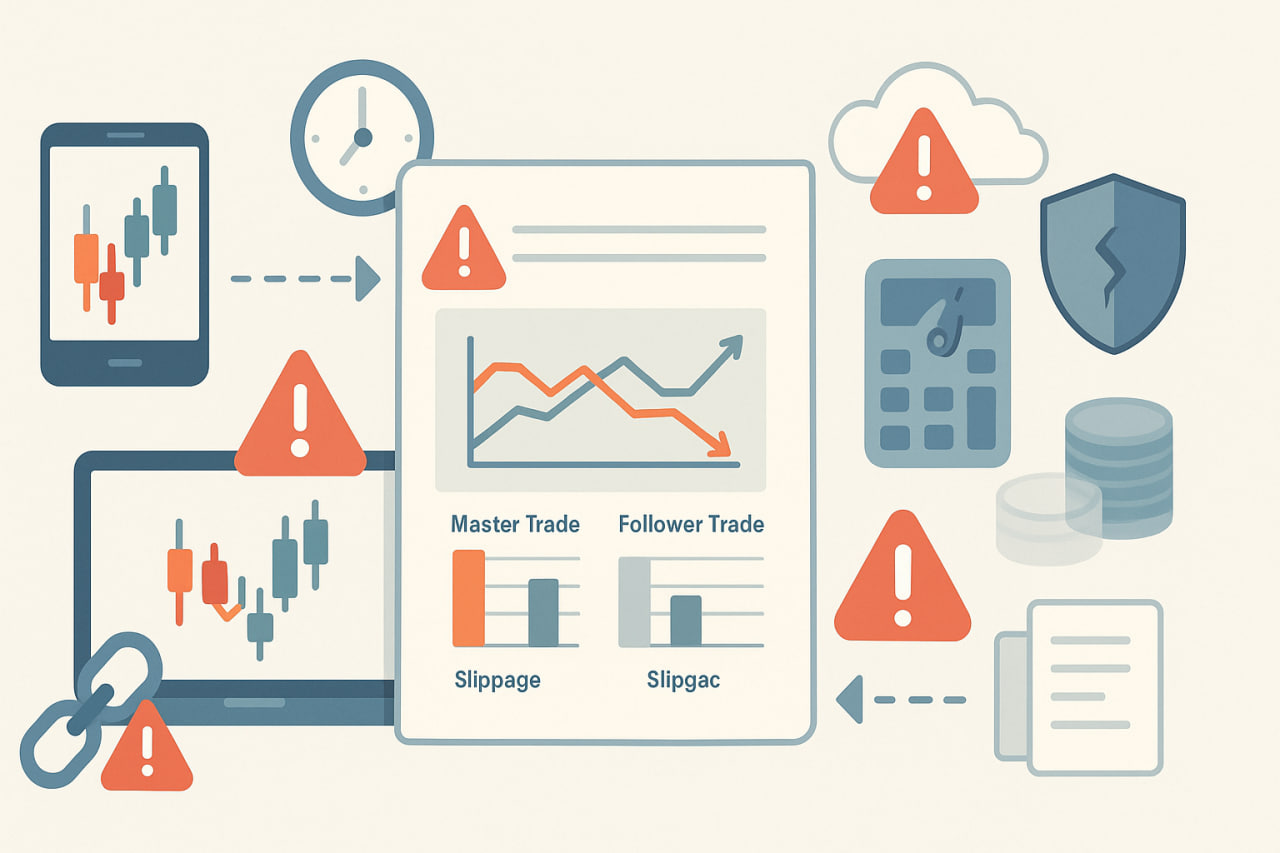
Mistakes most often arise not in formulas but in data and inconsistent accounting rules. A compact table will help quickly check weak spots in the process.
Risk / Mistake | What’s the Problem | Possible Consequences |
Late filing of the return | Deadlines missed | Interest, penalties, requests for explanations |
Underreporting income | Trades, funding, bonuses/cashback omitted | Additional assessments, penalties, and requests for source documents |
Loss of source data | No CSV, tx-hashes, statements | Cannot substantiate P&L, prolonged audits |
Ignoring fees and losses | Fees/losses not included in the calculation | Inflated tax base, tax overpayment |
Mixing personal and “work” funds | Transfers appear as income | Distorted base, risk of double-counting |
Switching methodology | FIFO/LIFO changed mid-period | Recalculation of operations, audit questions |
Different rate sources | Different rates are used for similar trades | Discrepancies, disputed amounts |
Confusion with transfers | Deposits/internal transfers treated as income | Artificially inflated result and tax base |
No balance reconciliation | The reconciliation formula doesn’t tie out across periods | Report errors, additional queries |
Incorrect classification of payments | Funding/interest/bonuses misclassified | Distorted tax base |
Quick prevention involves several key methods: using one method (FIFO/LIFO), one currency, and one rate source, conducting regular exports and backups, and performing mandatory balance reconciliation at period end.
Conclusion
In copy trading, realised profit is taxed; fees, funding and losses are accounted for under your country’s rules. To make the calculation defensible, determine the jurisdiction and accounting method in advance, collect complete exports from exchanges, fix rates on operation dates, and check the balance reconciliation. Filing on time with the necessary source data turns taxes from a risk into routine.