Why Sideways Markets Cause Losses
Contents
- Introduction
- Why Many Market Participants Incur Losses During a Sideways Market
- Key Reasons for Losses in a Sideways Market
- FOMO Psychology and Fear of Missing a Move
- Sideways Market Trading Strategies
- Risk Management in Low Volatility Conditions
- Conclusion
Introduction
Periods of consolidation in the crypto market often lead to losses. The price does not form a sustained uptrend or downtrend but instead fluctuates, it within a narrow trading range. At the same time, some traders continue to apply trend-following strategies, expecting a strong impulse that the market, in its current phase, does not produce.
In conditions of limited momentum, the number of false signals increases, stop orders are triggered more frequently, and trading results often consist of a series of small losses. In many cases, it is the specific market structure — rather than a single unsuccessful trade — that determines the overall outcome.
What Is a Sideways Market in Crypto

A sideways market, or flat, is a phase in which price moves within established boundaries: support below and resistance above. Instead of a directional trend, a range-bound pattern forms.
This stage is also referred to as consolidation. It is characterised by reduced volatility, a lack of strong momentum, and weak continuation after local breakouts. On Bitcoin and altcoin charts, this appears as repeated fluctuations within a channel, without forming consecutive higher highs or lower lows.
In practice, this creates the illusion of an impending reversal or acceleration. For example, the price approaches the upper boundary of the range, briefly breaks above it, and then quickly returns inside the corridor. Traders who entered expecting further movement incur losses, as the breakout lacks confirmation from volume and follow-through.
Why Many Market Participants Incur Losses During a Sideways Market
Understanding the nature of a range-bound market is important; however, trader behaviour often plays a decisive role. In the absence of a clear trend, uncertainty increases, which directly affects decision-making.
Key Reasons for Losses in a Sideways Market
Shift in Expectations
- The trader continues to expect a strong impulse move.
- The lack of follow-through increases the frequency of entries.
- A series of small losses begins to accumulate.
Decline in Risk Management Discipline
- Adjusting rules during live trading.
- Emotional decisions instead of systematic ones.
- Increasing risk per trade.
Psychological Pressure
- Intensified FOMO.
- Entries without volume confirmation.
- Repeated losses within the range.
More often, the problem is not the market phase itself, but a mismatch between the strategy and the current market structure.
Overtrading and the Urge to Always Be in a Position
Limited price movement creates the illusion of a “controlled” market. This can provoke excessive activity.
The desire to participate in every fluctuation within the range increases the number of trades. Commission costs rise, while potential profit within the corridor remains limited. A few consecutive unsuccessful entries can offset previous gains.
At the same time, traders may overestimate the probability of a breakout, which further increases position size or entry frequency. As a result, the account balance declines gradually — not because of one major loss, but due to repeated small losses and transaction costs.
False Breakouts and Stop-Loss Hunts
Liquidity tends to concentrate around support and resistance levels. Stop orders are often placed beyond these levels, making them attractive for short-term testing.
Price may break outside the range, trigger stop orders, and then return to the channel. For the trader, this looks like a “bad entry,” but from a market structure perspective, such movements are typical.
Without adapting position size and stop distance to current volatility, even a correct idea can lead to a loss. Therefore, in a narrow trading corridor, capital preservation and trade frequency control often become the priority.
Using Trend Strategies in a Sideways Market
Many trading systems are designed for directional movement: moving averages, breakout models, and momentum indicators. During consolidation, such approaches struggle due to the lack of follow-through.
A signal may form, but the market fails to develop it. In response, the trader may begin adjusting strategy parameters, adding filters, or increasing risk per trade, which reduces result stability.
Even a sound model can show negative performance if its logic does not align with the current market phase. The key factor, therefore, is not abandoning the system but adapting it to limited market dynamics.
FOMO Psychology and Fear of Missing a Move

During a sideways phase, participants anticipate a breakout, increasing emotional tension.
Typical FOMO mistakes:
- Premature entry into a position
- Opening a trade without volume confirmation
- Ignoring the range structure
- Trying to “catch the impulse” without a valid strategy signal
How to reduce FOMO impact:
- A clear trading plan
- Fixed entry rules
- Limiting the number of trades
- Strict risk control per position
How to Identify a Sideways Market
A sideways market can be identified by its chart structure: price remains within a narrow trading range for an extended period, holding between support and resistance levels. Volatility declines, candles become smaller, and sharp moves are rare.
Repeated tests of the same levels provide additional confirmation of consolidation. For example, several touches of resistance without a sustained breakout, while support continues to hold, indicate weak continuation.
Indicators can also help assess a ranging phase. RSI often fluctuates around the midpoint without reaching overbought or oversold zones. Bollinger Bands narrow, reflecting limited volatility.
When such signs are identified, it is better to adjust the trading plan in advance. In a narrow range, capital preservation often takes priority over waiting for a strong impulse move.
Sideways Market Trading Strategies
| Strategy | When It Works | Risk | Key Features |
|---|---|---|---|
| Range Trading | Clearly defined support and resistance levels | Low (if rules are followed) | Buy at support, sell at resistance |
| Scalping | Narrow range, high liquidity | Medium | Frequent trades, strict commission control |
| Trend Strategies | Not suitable for sideways conditions | High | Lack of follow-through movement |
Additional Recommendations
- Reduce position size
- Take profits within the range
- Do not expect a strong breakout without confirmation
When It’s Better Not to Trade
Sometimes the optimal strategy is staying out of the market. In a narrow range with limited momentum, trades become more random.
High uncertainty increases risk, as the price may briefly break beyond the range boundaries and then quickly return. If there is no clear signal and no well-defined entry point, it is more reasonable to preserve capital for future opportunities when a clear trend emerges.
Waiting for a breakout from consolidation often proves more beneficial than attempting active trading in conditions of limited volatility.
Risk Management in Low Volatility Conditions
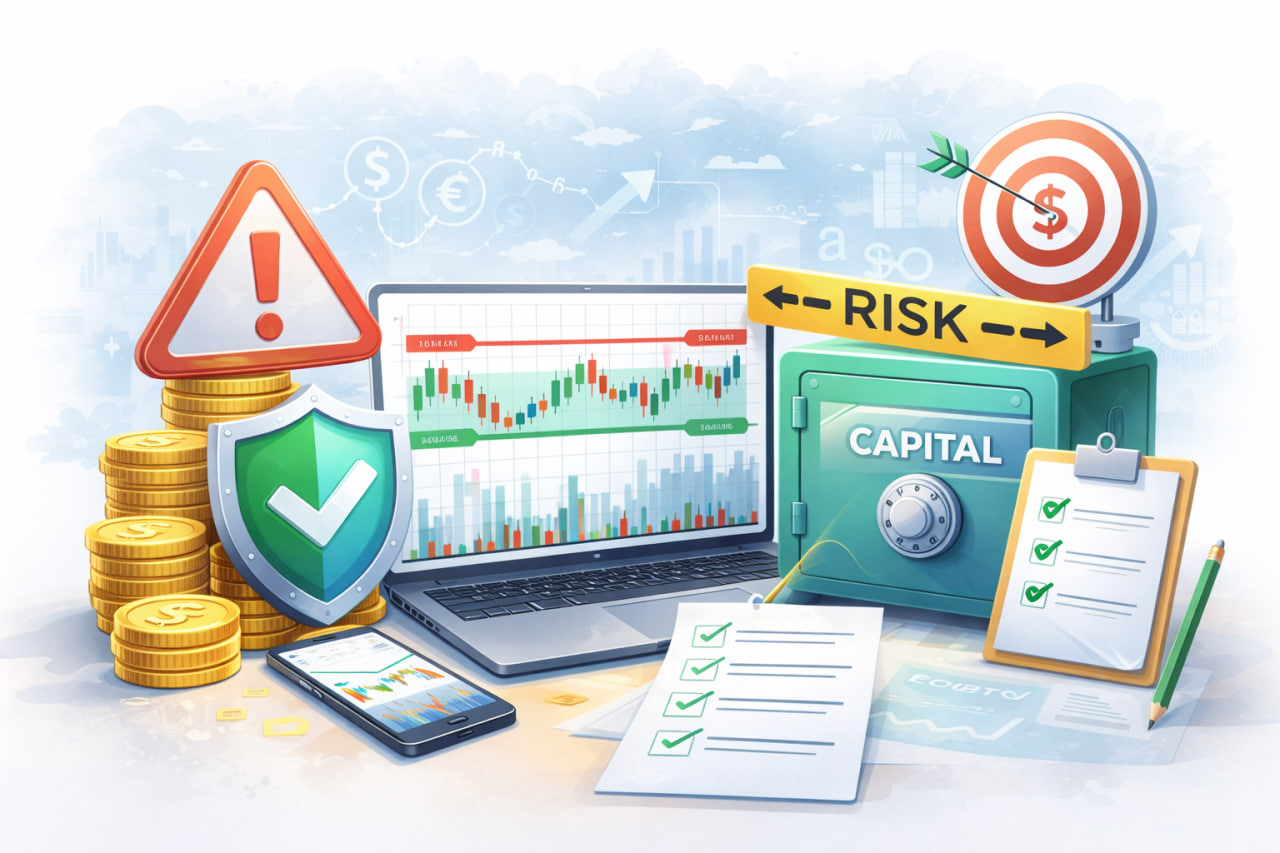
During sideways markets, risk management should be adapted accordingly. High leverage in a narrow range can lead to rapid losses. Stop orders should be placed with consideration of the range structure: a stop that is too tight may be triggered by normal price fluctuations, while one that is too wide increases potential losses.
It is advisable to reduce trading frequency. Every position should have a clear justification. Controlling the number of entries helps reduce psychological pressure and preserve capital. In such conditions, capital preservation often takes priority over aggressive trading.
Conclusion
A sideways market in crypto represents a period of limited dynamics and weak follow-through, requiring adjustments in trading approach.
Many market participants incur losses not because of the market structure itself, but due to behavioural factors and a mismatch between strategy and range conditions: overtrading, fear of missing out, and attempts to enter every impulse move.
Adapting the trading system, adjusting position sizes, reducing the number of trades, and maintaining strict risk management can help minimise losses and prepare for the next emerging trend.