Trading strategies using ChatGPT and LLM: is it time yet, or still too early?

Contents
- Introduction
- The Role of Artificial Intelligence in Modern Financial Markets
- Transition from Algorithms to Large Language Models
- What LLM Is and How ChatGPT Works in the Context of Trading
- Capabilities of Data and Information Analysis
- Application of ChatGPT and LLM in Trading Strategies
- Advantages of Using LLM in Trading
- Limitations and Technical Barriers
- Risks of Using AI in Crypto Trading
- Ethical and Regulatory Aspects
- Practical Market Readiness
- The Future of AI Trading and LLM Strategies
- Conclusion
Introduction
Artificial intelligence, large language models (LLMs), and ChatGPT have become widely discussed technologies in recent years in the context of financial markets, cryptocurrencies, and trading. The development of neural networks, machine learning, big data processing, and automation has led to the emergence of new forms of AI-driven algorithmic trading, where decisions are increasingly made not by humans but by intelligent systems.
Amid growing interest in trading with ChatGPT, automated trading systems, and neural network-based strategies, a key question arises: are these technologies ready for real, stable application in trading, or do they still remain an experimental field for testing and research?
The Role of Artificial Intelligence in Modern Financial Markets
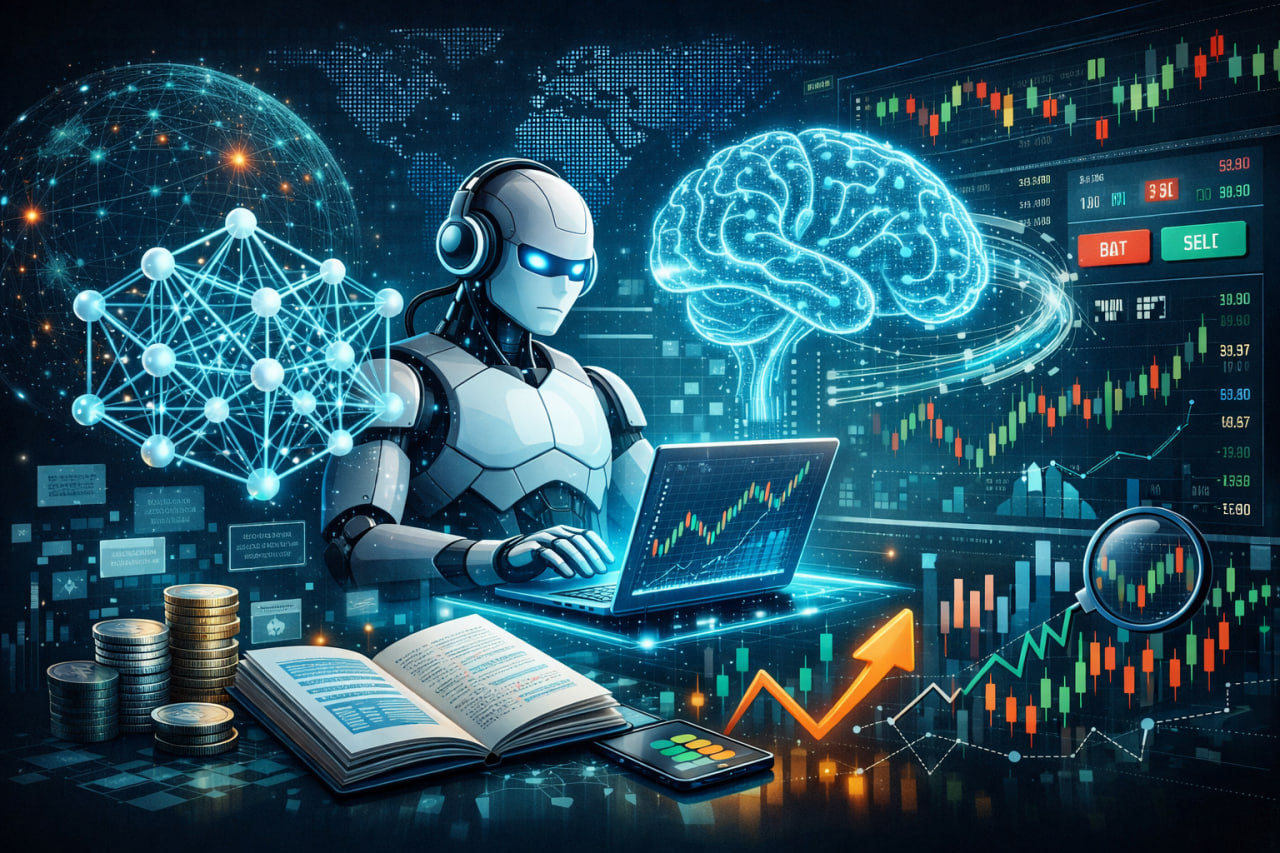
Algorithmic trading existed long before LLM models. Early systems were based on rigid rules, statistical models, and formalized strategies. Later, machine learning technologies emerged, allowing algorithms to adapt to the market, identify hidden patterns, and work with large datasets.
Over time, neural networks began to be actively used in analyzing market information, risk management, price forecasting, and automation of trading processes. This formed the foundation for the use of artificial intelligence in crypto trading, where complex data-processing models started to play a key role rather than just formal rules.
LLM models became a logical continuation of this evolution, expanding analytical capabilities through working with text, context, and unstructured data.
Transition from Algorithms to Large Language Models
Traditional trading algorithms are built on mathematical formulas, indicators, probabilistic models, and statistical relationships. They require strict formalization of entry and exit conditions, which limits their flexibility.
Large language models operate differently — they rely on context, semantic relationships, and probabilistic language structures. This allows them to analyze not only numerical data but also news, reports, social signals, texts, and behavioral patterns.
Comparison of Approaches
| Criterion | Classical Algorithmic Trading | LLM Models in Trading |
|---|---|---|
| Data Type | Numerical series, indicators | Texts, data, context |
| Decision Logic | Formal rules | Probabilistic interpretation |
| Flexibility | Limited | High |
| Adaptability | Depends on training | Context-dependent |
| Work with News | Indirect | Direct semantic analysis |
This difference forms a fundamentally new approach to automated trading strategies, where system intelligence is based not only on formulas but also on the interpretation of information.
What LLM Is and How ChatGPT Works in the Context of Trading
LLMs are large language models trained on massive volumes of textual data. They do not understand the market in the human sense, but they can identify semantic relationships, patterns, and contextual dependencies in information.
In trading, ChatGPT can be used as an analytical tool, an assistant for data interpretation, hypothesis generation, and information structuring. However, it is not a trading algorithm in the classical sense and does not make market decisions directly without external integration with trading systems.
A key limitation is that LLMs do not have direct market access and lack built-in risk management mechanisms unless these are implemented separately.
Capabilities of Data and Information Analysis
LLM models expand the boundaries of analytics by working with unstructured information sources:
- Analysis of news flows and macroeconomic reports
- Interpretation of on-chain data and blockchain metrics
- Processing of social signals and market sentiment
- Semantic analysis of reports and regulatory documents
This functionality forms the basis for AI-based crypto market analysis, where not only price but also the informational background plays a key role.
Application of ChatGPT and LLM in Trading Strategies
Generation of Trading Ideas and Hypotheses
AI can be used to form conceptual strategy models:
- Creating entry and exit scenarios
- Identifying logical market patterns
- Structuring trading hypotheses
- Developing risk model concepts
Using ChatGPT in cryptocurrency trading as an intellectual support tool rather than an automated trader makes its application more rational and reduces the risk of errors, since information is reviewed by humans and final decisions are also made by humans.
Market Data Analysis
LLMs can be applied to interpret complex information: macro data, news, market behavior, and fundamental factors. This strengthens the analytical component of strategies and reduces reliance solely on technical analysis.
Automation of Trading Processes
LLMs are used as a basis for creating trading bots, signal systems, and automated trading infrastructures. However, the models themselves more often act as an analytical core rather than an execution mechanism for trades.
Advantages of Using LLM in Trading

Key strengths of applying language models in trading strategies:
- High speed of information processing
- Scalability of analytical processes
- Ability to work with large volumes of data
- Flexibility in interpreting information
The strengths of LLMs form the foundation for AI-driven trading automation and the development of next-generation intelligent trading systems.
Efficiency and Decision-Making Speed
AI accelerates the cycle of market analysis and decision-making. In conditions of high volatility in the crypto market, this becomes a critical factor for the competitiveness of strategies.
Limitations and Technical Barriers
Despite their potential, LLM models face fundamental limitations: lack of true market understanding, dependence on data quality, and inability to distinguish reliable from distorted information without external filters.
Issues of Reliability and Signal Interpretation
Language models are prone to generating logically coherent but factually incorrect content. In trading, this can lead to false trading signals and flawed strategies.
Risks of Using AI in Crypto Trading

Main categories of risks when applying AI strategies:
- Financial losses due to errors and model hallucinations
- Technical failures and vulnerabilities
- Errors in data interpretation
- Manipulation of market information
Risk factors directly affect the question of how safe AI trading is in current conditions. Many of them are a direct barrier to the widespread adoption of AI in trading.
Volatility and Instability of the Crypto Market
High volatility, low liquidity, and price manipulation create an environment where even intelligent systems lose predictive stability.
Ethical and Regulatory Aspects
The use of AI in finance raises issues of responsibility, algorithm transparency, and compliance with regulatory requirements. In most jurisdictions, the legal framework for AI trading is still evolving.
Issues of Responsibility and Control
The key issue is determining accountability for decisions made based on AI. This creates legal and ethical risks for both investors and developers.
Practical Market Readiness
The market is in a transitional stage. Technologies exist, infrastructure is developing, but the mass adoption of AI trading strategies is limited by levels of trust, regulation, and technical maturity. This also increases the importance of strategy performance tracking in real market conditions.
Real Cases and Current Applications
Today, LLMs are more often used as analytical modules rather than autonomous trading systems. Their integration occurs within hybrid models that combine AI, algorithmic trading, and human oversight.
The Future of AI Trading and LLM Strategies

At this stage, AI is still actively evolving and gradually overcoming significant limitations that restrict its use in areas requiring high stability and reliability. It is likely that in the near future these limitations will largely disappear, and AI will firmly establish its place in trading and analytics.
Scenarios for Development and Scaling
The formation of standards, regulation, and infrastructure will create conditions for more stable integration of LLMs into trading processes.
Conclusion
The market is not yet ready for fully autonomous use of ChatGPT and LLMs in trading strategies without human oversight. The technologies already demonstrate strong analytical potential but remain support tools rather than full replacements for traders.
LLM models are at a formative stage as part of financial infrastructure. They are shaping the future of AI-driven algorithmic trading, but at the current stage require a hybrid approach that combines technology, human expertise, and strict risk management.