Why Traders Care About Open Interest on DEXs

Contents
- Introduction
- What Open Interest Is
- Why Open Interest on DEXs Has Become More Important
- How Open Interest Shows Leverage Buildup
- Open Interest and Market Positioning
- The Link Between Open Interest, Price, and Volume
- Open Interest and Liquidations
- What Open Interest Does Not Show
- How Traders Can Use Open Interest in Practice
- Common Mistakes Traders Make
- Why This Metric Matters Especially for Active Traders
- Conclusion
Introduction
Open interest shows where fuel has built up in the market. Price shows where an asset is moving right now. Volume shows how actively it is being traded. Open interest helps traders understand how many positions are still in the market and where leverage may be building up.
For active traders, this is especially important on DEXs, where perpetual futures trading is growing. These platforms give access to on-chain markets, new assets, and public data. That is why open interest on DEXs has become an important indicator for assessing risk, liquidations, and current market positioning.
What Open Interest Is
Open interest is the total size of active futures or perpetual contracts that have not yet been closed. Simply put, it is the sum of positions that are still in the market.
It is important not to confuse it with trading volume. Volume shows how many contracts are traded over a selected period. Open interest shows how many contracts remain open. The basic difference between these metrics is explained well by Investopedia: volume is tied to trading activity, while open interest is tied to the number of unclosed contracts.
Here is a simple example. If two traders open a new futures trade, open interest rises. If both close their positions, it falls. If one trader opens a position while another closes an old one, the metric may barely change.
Open interest helps a trader understand:
- How many positions remain in the market
- Whether interest in the asset is growing
- Whether leverage is building up
- Whether the market may become sharper when price moves
Why Open Interest on DEXs Has Become More Important

Perpetual futures have long been one of the main instruments in crypto trading. They are used for speculation, hedging, and leveraged trading. In a study on perpetual swaps, open interest is described as an important metric for assessing activity, sentiment, liquidity, and risk in derivatives markets.
In the past, most activity was on centralized exchanges. Now some traders are moving into the on-chain environment. The reasons are clear: fast access to new assets, public data, less dependence on a single company, and trading directly through a wallet.
DEX perps have become more visible because traders want to see more than price. They need the market structure: where leverage exists, where the crowd is leaning to one side, and where a sharp move may start.
The DEX market is interesting for traders for several reasons:
- Access to on-chain data
- Fast launch of new markets
- Trading through a wallet
- Less dependence on a centralized venue
- More transparent activity across several metrics
How Open Interest Shows Leverage Buildup
When open interest rises quickly, it often points to an inflow of new positions. In perpetual futures markets, some of those positions are almost always opened with leverage. The more leverage there is in the market, the stronger price can react to sharp moves.
If price rises and open interest rises too, it can look like a strong trend. New participants enter the market, they open positions, and the move receives more fuel. But there is another side. If too many traders are positioned in the same direction, the market becomes fragile.
Leverage becomes dangerous when price moves against the majority. Liquidations then begin. Some positions close automatically, price gets a new impulse, and more liquidations follow. This is how an ordinary correction can turn into a sharp sell-off.
Open Interest and Market Positioning
Open interest does not show who is right. It shows that many active positions have accumulated in the market. To understand market positioning, it should be viewed together with price, funding rates, volume, and liquidations.
For example, high open interest alone does not mean that traders should buy or sell. It says only one thing: the market is loaded. If funding rates are also high and price has been rising for a long time, it may suggest that many traders are long. If the price drops sharply, that crowd can become a weak point.
Signs of overheated positioning may include:
- Open interest is rising quickly
- Price has already moved strongly in one direction
- Funding rates have become too high
- Social media is full of the same expectations
- Liquidation levels are close to the current price
The crowd is not dangerous because it is always wrong. The problem is different: when too many participants are positioned the same way, a move against them can become very fast.
The Link Between Open Interest, Price, and Volume
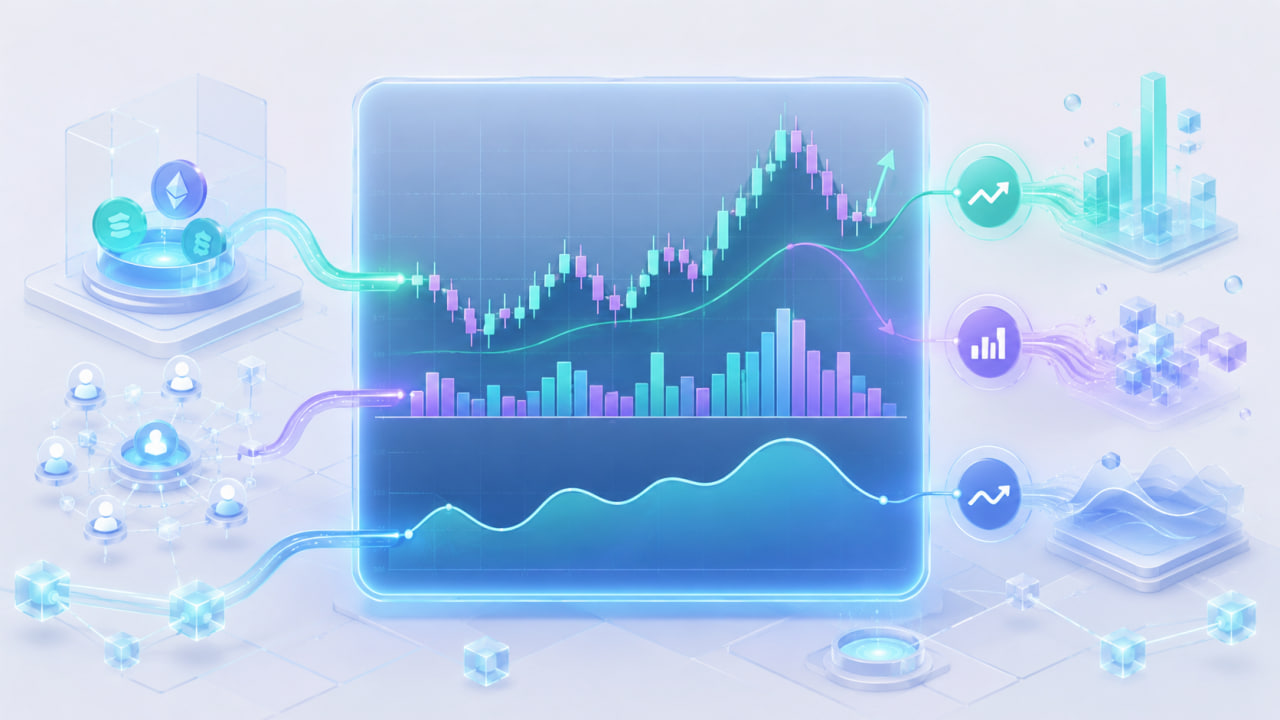
Open interest is useful only when combined with other data. The same rise in the metric can mean different things.
| Scenario | What it may mean | What the trader should watch |
|---|---|---|
| Price rises, open interest rises | New positions enter the market | Whether the market is overheated |
| Price rises, open interest falls | Shorts may be closing | Whether new demand is present |
| Price falls, open interest rises | Traders are building shorts or a battle is underway | Whether the risk of a sharp rebound is growing |
| Price falls, open interest falls | Positions are being closed | Whether the sell-off phase may be ending |
Rising price and rising open interest often look like trend confirmation. But if the move is already strong and leverage grows too quickly, entry risk increases.
Rising price and falling open interest may point to short positions closing. Such a move can be sharp, but it is not always sustainable. If new demand does not follow, the move may fade quickly.
Falling price and rising open interest may point to short buildup. Sometimes this supports the decline. But if the market reverses sharply, those shorts can become fuel for a rebound.
Open Interest and Liquidations
A liquidation happens when a leveraged position can no longer withstand a price move against the trader. The exchange closes that position automatically. This protects the system from a negative balance, but for the trader it means losing part or all of the collateral.
Mass liquidations amplify the move. If many longs are using leverage, a sharp price drop can trigger a chain of position closures. If many shorts are using leverage, a sharp rise can cause a short squeeze.
Open interest helps traders see in advance when the market has become sensitive. This is especially true when a high reading sits near an important price level. In such a zone, even a small move can trigger a strong reaction.
What Open Interest Does Not Show
Open interest is not a ready-made buy or sell signal. It does not say exactly where the price will go. It does not show the quality of a trade. It only helps traders understand how many positions and how much risk have built up in the market.
The main mistake is reading this metric in isolation. Without price, volume, liquidity, and funding rates, it can easily mislead. High open interest can be a sign of a strong trend. But it can also be a sign of overheating.
Open interest does not answer these questions:
- Exactly where price will go
- Who is right in the market
- Where the perfect entry point is
- Whether a level will break
- When a liquidation cascade will begin
A proper assessment needs context: price, volume, funding rates, liquidation zones, asset liquidity, and Bitcoin’s behavior. Without that, open interest turns into noise.
How Traders Can Use Open Interest in Practice

Open interest helps assess the strength of a move. If price is rising, volume is high, and open interest is rising too, the move may be supported by new positions. If price is rising while open interest is falling, it is worth checking whether the move is simply driven by short covering.
The metric also helps assess entry risk. If an asset has already risen strongly, funding rates are high, and open interest has jumped sharply, a late entry can be dangerous. In that situation, the market is often overloaded with leverage.
But one market indicator is not enough. A trader needs to see not only open interest on DEXs, but also their own position load: total portfolio size, drawdown, active trades, risk, and account changes. That is why active trading benefits from real-time portfolio statistics, which help traders understand faster how market overheating affects their own positions, not just the asset chart.
A practical approach can look like this:
- View open interest together with price
- Compare it with volume
- Check funding rates
- Look at liquidation zones
- Consider asset liquidity
- Do not enter only because the metric is rising
Another scenario is the search for zones of increased volatility. If open interest grows quickly before an important level, news event, or breakout, a sharper move may follow. It may not necessarily go up or down. But the chance of a strong reaction becomes higher.
Common Mistakes Traders Make
Many traders look at open interest without price direction. That is a mistake. A rise in the metric while price is rising and a rise while price is falling are different situations.
Another mistake is treating high open interest as a safe sign. Sometimes it points to market strength. But sometimes it shows that the market is overloaded with positions. In that case, the entry may be late.
The third mistake is ignoring asset liquidity. In low-liquidity markets, even a small amount of leveraged positions can create a strong move. This is especially visible in new tokens and smaller perpetual futures markets.
Why This Metric Matters Especially for Active Traders
An active trader works with more than price direction. They need to understand the structure of risk. Open interest adds another layer of analysis: how many positions are in the market, whether leverage is growing, and whether the crowd is too confident in one direction.
For short-term trading, this is especially important. In perpetual futures markets, prices can react quickly to liquidations, funding rates, and a sharp buildup of positions. Open interest helps traders see when the market has become too loaded.
This does not make the forecast exact. But it helps traders understand the conditions of a trade better. In trading, what often matters is not a perfect forecast, but a clear understanding of risk.
Conclusion
Open interest on decentralized exchanges has become an important indicator for traders because it shows leverage buildup, position activity, and possible zones of sharp moves.
But open interest cannot be used on its own. It does not replace price, volume, liquidity, funding rates, or the broader market context. It is not a buy or sell button. It is a market load sensor.
If price shows the direction of movement, open interest shows how much fuel may be behind that movement. That is why active traders increasingly watch this metric on DEXs and in perpetual futures markets.